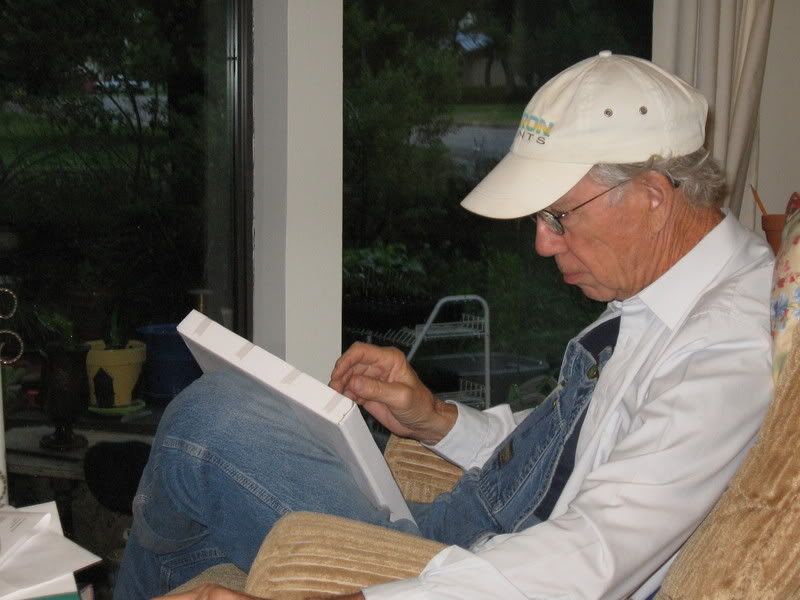
“Fall seven times, stand up eight.” Good advice, inspiring words, but sometimes when we fall, “all the king’s horses and all the king’s men,” cannot get us up again. Sometimes we are knocked down for the ten count. Working in my wild, naturalistically landscaped yard, I have fallen “seven” times. Always gotten up. However, in January 1999, I was stretched out at the top of a sixteen-foot ladder, reaching out and up another ten feet with a pruning saw to cut mistletoe out of a mesquite tree. I found myself talking to myself: “Roark, you are sixty-five years old; your bones are brittle with age; you’ve got to stop doing this. If you fell, you would break something, perhaps your neck or a hip.” I would not have been able to get up and climb back up the ladder. I’ve not pruned the mistletoe in nine years.
“Watch your step,” we’re told, “Don’t fall down.” But the road of life is too precarious, falling is inevitable. Pay attention as we may, life will trip us up from time to time. Why did Humpty-Dumpty fall? Was he pushed? Did he lean over too far and lose his balance? Was his seat slippery? Whatever, it was a great fall. We all fall down. Some slip on ice, some are knocked down, some are thrown from horses, some are tripped. Broken hearts, grief, disappointment, bankruptcy put some of us down.
Some have that something in their makeup that enables and drives them to get back up no matter how often nor how hard they fall. They don’t need Japanese proverbs. Others just don’t seem to have the stuff in them to pull themselves back up, especially if they have a Humpty-Dumpty fall. The Japanese proverb merely pushes them further down. The great majority, however, can get up eight times, but needs encouragement if they are to keep getting up again and again. The proverb may provide an adequate stimulus, but often more is needed. Discouragement is one of the most universal human emotions. Everyone needs encouragement occasionally. That is where we can step in, offering a hand to the fallen, a word and smile that can restore confidence. Few things are as needed or as productive. And anyone can do it.
Tuesday, July 6, 2010


Sunday, May 23, 2010
Ostensibly Christian
Ostensibly Christian
Kathleen Norris, Cloister, p. 73
[In a California radio interview on Pacifica radio] “‘Do you consider yourself a Christian?’ my host asked. I sighed and said, ‘My problem with that is that so many people who publicly identify themselves as Christians are such jerks about it.’”
I cringe when I see these jerks with simplistically “Christian” messages on their t-shirts and bumper stickers or when I see them praying over their food in restaurants. I don’t label as jerks everyone who follows these practices; many are not. Many are sincere and unthinking Christians. I have yet to see a t-shirt sporting the Jesus’ words according to Matthew 6:1, “Beware of practicing your righteousness before men to be noticed by them; otherwise you have no reward with your Father who is in heaven.”
One reason ostensible Christian testimony bothers me is that often I know these people. I know that much of their daily practice--speech, attitude, action--is contrary to clear biblical guidelines. If I were not a Christian, if I were not already “born again”, neither they nor their message would attract the least of my interest. Like everyone else I would find myself paying more to the person than to what they were advertising.
The same holds for so many of the cute “Christian” messages that show up on the marquis in front of churches. They make some of the insiders feel good, but to the outside passerby they may look either innocuous or offensive. Nearly always they see them as childish.
[According to Of Fiction and Faith] somewhere Doris Betts says, “Christian spoils into a rancid adjective.”
Kathleen Norris, Cloister, p. 73
[In a California radio interview on Pacifica radio] “‘Do you consider yourself a Christian?’ my host asked. I sighed and said, ‘My problem with that is that so many people who publicly identify themselves as Christians are such jerks about it.’”
I cringe when I see these jerks with simplistically “Christian” messages on their t-shirts and bumper stickers or when I see them praying over their food in restaurants. I don’t label as jerks everyone who follows these practices; many are not. Many are sincere and unthinking Christians. I have yet to see a t-shirt sporting the Jesus’ words according to Matthew 6:1, “Beware of practicing your righteousness before men to be noticed by them; otherwise you have no reward with your Father who is in heaven.”
One reason ostensible Christian testimony bothers me is that often I know these people. I know that much of their daily practice--speech, attitude, action--is contrary to clear biblical guidelines. If I were not a Christian, if I were not already “born again”, neither they nor their message would attract the least of my interest. Like everyone else I would find myself paying more to the person than to what they were advertising.
The same holds for so many of the cute “Christian” messages that show up on the marquis in front of churches. They make some of the insiders feel good, but to the outside passerby they may look either innocuous or offensive. Nearly always they see them as childish.
[According to Of Fiction and Faith] somewhere Doris Betts says, “Christian spoils into a rancid adjective.”
Friday, April 2, 2010
Forced to Smile
Forced to Smile
“Jerome’s [late 4th century] own character was notoriously difficult. . . . . It amuses me greatly to envision Jerome, of all people, shining like a star, and hating every minute of it. As we’re leaving the church, I mention this to one of the monks. ‘Ah, poor Jerome,’ he said, ‘forced to smile and sing for all of eternity. Maybe that’s his punishment’.’‘
--Kathleen Norris
Would heaven be hell if John Piper and Clark Pinnock found they were together for all eternity, or Paige Patterson and Art Allen? How many Christians are there who have no real interest in developing the whole range of Christian virtues or reaping the fruit of the Spirit? We want the forgiveness of sin and the acceptance of God; more to the point, we want to avoid hell, and perhaps, get to go to heaven. We may even want to become a serious Christian to a degree, on certain points, but might genuinely cringe at even the thought of actually allowing the Spirit to rule and reshape every dimension of our thoughts, feelings, decisions, and actions.
“Jerome’s [late 4th century] own character was notoriously difficult. . . . . It amuses me greatly to envision Jerome, of all people, shining like a star, and hating every minute of it. As we’re leaving the church, I mention this to one of the monks. ‘Ah, poor Jerome,’ he said, ‘forced to smile and sing for all of eternity. Maybe that’s his punishment’.’‘
--Kathleen Norris
Would heaven be hell if John Piper and Clark Pinnock found they were together for all eternity, or Paige Patterson and Art Allen? How many Christians are there who have no real interest in developing the whole range of Christian virtues or reaping the fruit of the Spirit? We want the forgiveness of sin and the acceptance of God; more to the point, we want to avoid hell, and perhaps, get to go to heaven. We may even want to become a serious Christian to a degree, on certain points, but might genuinely cringe at even the thought of actually allowing the Spirit to rule and reshape every dimension of our thoughts, feelings, decisions, and actions.
Monday, March 29, 2010
Becoming a Christian
At a meeting, Kathleen Norris says she was humbled by hearing so esteemed a theologian as Karl Rahner cry out, "I have still to become a Christian."
Our bi-monthly denominational news journal always includes a simple outline of “How to Become a Christian.” At the denominational university where I teach, regularly we hear chapel speakers tell us how to become a Christian. We have many students who are committed to asking people whether they are a Christian; if they answer in the negative, they tell them how to become a Christian. After reflecting on this particular evangelistic use of language that I’ve heard all my life, I ‘ve come to believe they are really concerned to tell, not, how to become a Christian, but, how to come to be a Christian. Once the appropriate steps are taken one is a Christian. It is a done deal. Eternally irreversible.
I’ve been around Christians ever since my father left the farm and began preaching when I was less than two years old. I spent ten yeas in theological seminaries, and have been teaching Christian Studies in a denominational university for the past thirty years. Christians come in all shapes, sizes, attitudes, political and economic leanings. But they all come in shadings; they are all Christian “to a degree.” “If any man be in Christ,” the New Testament says, “he is a new creature. Old things are passed away, behold, all things are become new.” Among the thousands of Christians I have known and observed, I have never seen one for whom all old things have passed away, and it takes little exposure to reveal that not all aspects of their thought, mood, attitude and action have become new.
They may be in the process of becoming a Christian. Old things may be in the process of being shed or tossed aside. Their life increasingly take on new and more Christlike dimensions, but they still have a ways to go before they are truly Christ-ian. The apostle Paul write that he continued to “press on,” toward the goal; he realized he had “not yet attained it.” Repeatedly he wrote to those he called “brothers in Christ,” commending them for their Christian character and deeds, but urging them to become yet more Christian, to mature in Christ, to more completely become what they already are.
So, like Rahner, we would do well to realize that, although we may come to accept the salvation offered by the gracious God who accepts us just as we are, we are disciples–followers, learners, apprentices–of Jesus. Christianity is a process. We all must “press on” toward that higher ground beyond, a place more enjoyable than we’ve yet known, with a deeper, richer peace than we can now imagine.
Our bi-monthly denominational news journal always includes a simple outline of “How to Become a Christian.” At the denominational university where I teach, regularly we hear chapel speakers tell us how to become a Christian. We have many students who are committed to asking people whether they are a Christian; if they answer in the negative, they tell them how to become a Christian. After reflecting on this particular evangelistic use of language that I’ve heard all my life, I ‘ve come to believe they are really concerned to tell, not, how to become a Christian, but, how to come to be a Christian. Once the appropriate steps are taken one is a Christian. It is a done deal. Eternally irreversible.
I’ve been around Christians ever since my father left the farm and began preaching when I was less than two years old. I spent ten yeas in theological seminaries, and have been teaching Christian Studies in a denominational university for the past thirty years. Christians come in all shapes, sizes, attitudes, political and economic leanings. But they all come in shadings; they are all Christian “to a degree.” “If any man be in Christ,” the New Testament says, “he is a new creature. Old things are passed away, behold, all things are become new.” Among the thousands of Christians I have known and observed, I have never seen one for whom all old things have passed away, and it takes little exposure to reveal that not all aspects of their thought, mood, attitude and action have become new.
They may be in the process of becoming a Christian. Old things may be in the process of being shed or tossed aside. Their life increasingly take on new and more Christlike dimensions, but they still have a ways to go before they are truly Christ-ian. The apostle Paul write that he continued to “press on,” toward the goal; he realized he had “not yet attained it.” Repeatedly he wrote to those he called “brothers in Christ,” commending them for their Christian character and deeds, but urging them to become yet more Christian, to mature in Christ, to more completely become what they already are.
So, like Rahner, we would do well to realize that, although we may come to accept the salvation offered by the gracious God who accepts us just as we are, we are disciples–followers, learners, apprentices–of Jesus. Christianity is a process. We all must “press on” toward that higher ground beyond, a place more enjoyable than we’ve yet known, with a deeper, richer peace than we can now imagine.
Tuesday, February 16, 2010
Unsaid
A life-changing experience when, several years ago, I read that when we die there is "so much left unsaid." I felt struck in the pit of the stomach. I had so much in me, so much I thought of importance, that had never been said to any of the appropriate people.
Starting with my wife at the head of the list, I made a commitment to leave nothing unsaid. And since I knew not the span of my life, I began immediately finding occasion to say it all. To her, the rest of the family, colleagues, friends, and enemies (yes, I had some things to say to them). As a university professor, I made it a point to include as much as possible of what I wanted to say (within the parameters of my discipline) in the classroom.
There was so much, however, that went beyond family, friends, enemies. I've done a good job of getting most of that said. In that sense I am ready to die, But....
So much still in me that needed to be said (at least that is what I think and smartingly feel). So, upon retirement, I began writing a couple of books and thinking of another or two. Then I began blogging and recently started three different Twitter accounts. I intend to continue writing, for public consumption, the rest of my life, God willing. I want to get it said, as much as in me is possible.
And you? If you were to die soon, how much that you want to say, ought to say, would be left unsaid?
Starting with my wife at the head of the list, I made a commitment to leave nothing unsaid. And since I knew not the span of my life, I began immediately finding occasion to say it all. To her, the rest of the family, colleagues, friends, and enemies (yes, I had some things to say to them). As a university professor, I made it a point to include as much as possible of what I wanted to say (within the parameters of my discipline) in the classroom.
There was so much, however, that went beyond family, friends, enemies. I've done a good job of getting most of that said. In that sense I am ready to die, But....
So much still in me that needed to be said (at least that is what I think and smartingly feel). So, upon retirement, I began writing a couple of books and thinking of another or two. Then I began blogging and recently started three different Twitter accounts. I intend to continue writing, for public consumption, the rest of my life, God willing. I want to get it said, as much as in me is possible.
And you? If you were to die soon, how much that you want to say, ought to say, would be left unsaid?
Monday, February 15, 2010
Secrets, What to Do with Them
"...a secret is something that is revealed to one person at a time." --John LeCarre
I have a secret. What do I do with it/ If I keep it to myself, it is a true secret? It is private part of who I am. It is not public. No one else knows about this part of me. It is a part of me that no one can own. It is part of what makes me a distinctive person.
If I tell someone else, anyone else, it is no longer a secret. "Two can keep a secret if one of them is dead." It is a rare person who can keep a secret. It is risky and potentially dangerous to share it with anyone. If they tell someone else, it is likely to spread, and that which was unique to me is now part of the public perception of me, and may become a subject of gossip.
On the other hand, if I tell my closest friend, a friend who I know can keep secrets, then my friend and I have something that we alone can share. It gives our friendship a deeper and richer element. It enhances intimacy.
If I tell several close friends, and if they are people who can be trusted to keep confidences, we become a close-knit group sharing something that distinguishes us from the rest of the world. We appreciate the trust and support.
On still another hand it is common for us to, as LeCarre says, to tell one person at a time, telling each of them to tell no one else. We ask them not to, but we continue telling several. At some point secrecy is likely to break down.
Telling secrets, our own or one entrusted to us by someone else, is risky and often dangerous. On one hand it is a way to enhance intimacy and bind people more closely together, on the other hand it is one of the most common ways of damaging the relationship we had with someone whose trust we have now betrayed.
So, what are we to do with our secrets? Be mighty careful about them.
On the other hand,
I have a secret. What do I do with it/ If I keep it to myself, it is a true secret? It is private part of who I am. It is not public. No one else knows about this part of me. It is a part of me that no one can own. It is part of what makes me a distinctive person.
If I tell someone else, anyone else, it is no longer a secret. "Two can keep a secret if one of them is dead." It is a rare person who can keep a secret. It is risky and potentially dangerous to share it with anyone. If they tell someone else, it is likely to spread, and that which was unique to me is now part of the public perception of me, and may become a subject of gossip.
On the other hand, if I tell my closest friend, a friend who I know can keep secrets, then my friend and I have something that we alone can share. It gives our friendship a deeper and richer element. It enhances intimacy.
If I tell several close friends, and if they are people who can be trusted to keep confidences, we become a close-knit group sharing something that distinguishes us from the rest of the world. We appreciate the trust and support.
On still another hand it is common for us to, as LeCarre says, to tell one person at a time, telling each of them to tell no one else. We ask them not to, but we continue telling several. At some point secrecy is likely to break down.
Telling secrets, our own or one entrusted to us by someone else, is risky and often dangerous. On one hand it is a way to enhance intimacy and bind people more closely together, on the other hand it is one of the most common ways of damaging the relationship we had with someone whose trust we have now betrayed.
So, what are we to do with our secrets? Be mighty careful about them.
On the other hand,
Friday, February 12, 2010
The Cost of Morality
In Susan Howatch’s novel, Sins of the Fathers, Teresa says to the banker, “I don’t believe in capitalism. I think it’s immoral.” He replies, “Morality is like mink, it’s great if you can afford it.”
In Twenty-first-Century society in the United states, morality is not on the “in” list of concepts. It definitely is “out.” The bottom line is in. The self is in. Success is in. The moral perspective on things is considered a nice but outdated concept. Nietzsche’s philosophy that morality is a sign of weakness, is for the loser, and needs to be revised in an upside-down manner is, perhaps unconsciously, the ruling philosophy.
“Morality is great if you can afford it”? That is true. If we are moral,that is, if we insist on doing the “right” thing, we are apt to lose out to those who insist on making a profit, winning first place, get promoted. Morality is okay to speak of if you already have all your bases covered, all your ducks in a row. Otherwise, morality is expendable.
Those of us who insist on being moral, acting ethically, doing the right thing, need to be aware that it often will cost us. True morality is aware of the price that must be paid, but knows that it will cost more in a different kind of coin if we choose to act unethically. If nothing else, our conscience will powerfully and painfully remind us of the cost of immorality.
Can we afford to do the right thing whatever the cost, or must we count the cost before we decide to live morally?
In Twenty-first-Century society in the United states, morality is not on the “in” list of concepts. It definitely is “out.” The bottom line is in. The self is in. Success is in. The moral perspective on things is considered a nice but outdated concept. Nietzsche’s philosophy that morality is a sign of weakness, is for the loser, and needs to be revised in an upside-down manner is, perhaps unconsciously, the ruling philosophy.
“Morality is great if you can afford it”? That is true. If we are moral,that is, if we insist on doing the “right” thing, we are apt to lose out to those who insist on making a profit, winning first place, get promoted. Morality is okay to speak of if you already have all your bases covered, all your ducks in a row. Otherwise, morality is expendable.
Those of us who insist on being moral, acting ethically, doing the right thing, need to be aware that it often will cost us. True morality is aware of the price that must be paid, but knows that it will cost more in a different kind of coin if we choose to act unethically. If nothing else, our conscience will powerfully and painfully remind us of the cost of immorality.
Can we afford to do the right thing whatever the cost, or must we count the cost before we decide to live morally?
Thursday, February 11, 2010
Censoring the Bible
“In recent years, some Benedictine houses, particularly women’s communities, have begun censoring the harshest of the psalms, often called the ‘cursing psalms,’ from their public worship.” --Kathleen Norris, Cloister, p. 97.
The church, across most of the centuries of its history, has acquired quite a reputation for censoring literature. Most unchurched people would be quite surprised to learn that the church, in its actual practice, censors the Christian Bible rather thoroughly. Thomas Jefferson is reputed to have taken his pen knife and cut out of his Bible every reference to anything miraculous, anything supernatural. It is still possible to buy copies of The Jefferson Bible. Christians decry Jefferson’s truncation, but themselves routinely do much the same.
If the Bible were made into a Hollywood movie, and if the movie were faithful to the text, much of it could not receive a “G” rating. Rather much of it would have to be rated either “PG-13,” or “R,” both for sex and violence. See in particular much of Joshua and Judges or the entire story of the rape of Dinah in Genesis 34 or the story of Judah--from whom the Jews get their name--and his visit with a “prostitute.” Read the entire story of David. When we tell these stories in Sunday School classes, we edit out those parts that would not be “in good taste” to read in polite company.
In our Bible study groups and in Sunday sermons, we get uneasy with parts of the Bible not only for sex and violence, but also because it is also comfortable with bathroom language, and with strong language of rebuke, bitterness and hatred. We don’t talk that language, or about those things in church, although we do everywhere else.
Darkness and ugliness are part of human reality and therefore a part of biblical reality. But because we see ourselves as clean, respectable, and nice people, we find that there is much in the Bible that it just would not be right to read publicly in church.
Wednesday, February 3, 2010
The World's Tears
"All you who sleep tonight
Far from the ones you love,
No hand to left or right,
And emptiness above--
Know that you aren't alone.
The whole world shares your tears,
Some for two nights or one,
And some for all their years."
--Vikram Seth
Whatever you think of Jesus of Nazareth, if you read his story in the four gospels, you know that he shares the world's tears. He understands, and cares, and some of us think he has done and is doing something redemptive about those tears.
Far from the ones you love,
No hand to left or right,
And emptiness above--
Know that you aren't alone.
The whole world shares your tears,
Some for two nights or one,
And some for all their years."
--Vikram Seth
Whatever you think of Jesus of Nazareth, if you read his story in the four gospels, you know that he shares the world's tears. He understands, and cares, and some of us think he has done and is doing something redemptive about those tears.
Subscribe to:
Comments (Atom)